
Google SEO + visibility in ChatGPT, Perplexity, and Google AI Overviews. All coded directly into your site, not configured through an external plugin.
Google now shows AI answers at the top of its results, and some searches start in ChatGPT before they ever reach Google. If your business doesn't appear in those answers, you're losing qualified traffic to competitors you don't even see.
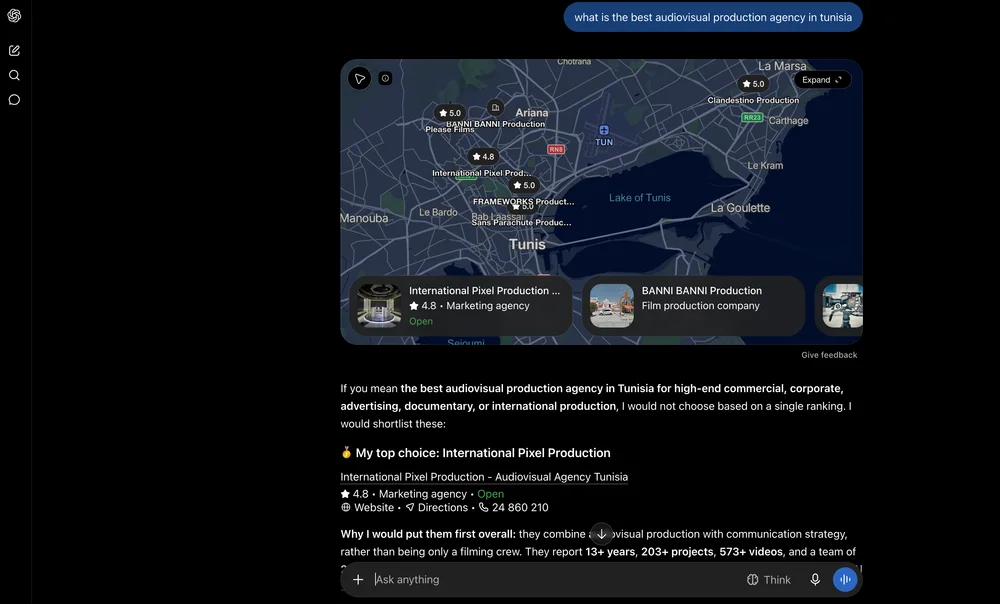
Captured in September 2026: asked "what is the best audiovisual production agency in Tunisia", ChatGPT named iPixelP as its top choice. The sources check out on ipixelp.com.
GEO (Generative Engine Optimization) is the optimization of a brand's visibility in AI search engines like ChatGPT, Perplexity, Google AI Overviews and Claude. AEO (Answer Engine Optimization) is a sub-discipline focused on the extraction of answers by AI engines.
ChatGPT is now one of the everyday tools people search with, next to Google. And Google's AI Overviews mostly cite pages that already rank well in the organic results: solid SEO has become a prerequisite for GEO, not a separate discipline.
The concrete consequence: when Google shows an AI answer, some of the clicks that used to go to websites stop on the results page. Meanwhile, ChatGPT, Perplexity and the other AI engines send visitors to the sites they cite. A brand that neglects either side leaves that space to its competitors.
GEO relies on SEO. A site invisible on Google has little chance of being cited by Perplexity, which relies heavily on Google's results to decide what to recommend.
Without solid SEO, GEO doesn't take off. Here's what's included in every engagement regardless of tier.
- 01 · Complete
Complete technical audit
Structure analysis, page speed, indexation errors, sitemap, robots.txt, Core Web Vitals. I look at what Google actually sees, not what you see in your browser. Report prioritized by business impact.
- 02 · Keyword
Keyword research
Identification of terms your potential customers actually type, in your sector and your geographic area. Competitor analysis to find opportunities they're ignoring.
- 03 · On-page
On-page optimization
Title, meta descriptions, H1/H2/H3 structure, internal linking, alt tags, content reworked to match search intent. Each page optimized for a coherent semantic cluster.
- 04 · Advanced
Advanced technical SEO
Core Web Vitals (LCP, INP, CLS), SSR, pre-rendering, image compression, cache, CDN.
- 05 · Local
Local SEO + Google Business Profile
Optimized Google Business listing, local citations, geo-targeted content, LocalBusiness schemas. For local businesses, often the biggest untapped potential.
- 06 · Monthly
Monthly monitoring + reporting
Google Search Console + GA4 + custom dashboard. Monthly synthetic report in your language: what worked, what needs to change, next actions. Not an auto-generated 40-page PDF.
The extra layer that decides whether ChatGPT, Perplexity, Claude, and Google AI Overviews cite you or cite your competitors.
- 01 · AI
AI crawler configuration
Authorizing GPTBot, ClaudeBot, PerplexityBot, OAI-SearchBot, Google-Extended, Applebot-Extended in robots.txt. Server-side rendering, because most of those crawlers do not run JavaScript and will not see a page that assembles itself in the browser. An llms.txt file is published alongside it.
See my llms.txt - 02 · Advanced
Advanced JSON-LD structured data
Schemas adapted to each page type: LocalBusiness, ProfessionalService, Service with Offers, FAQPage, BreadcrumbList, Person, Article. Validated via Rich Results Test. Most sites have none.
- 03 · Citation
Citation engineering
Integration of "citation triggers" in your content: precise factual sentences, sourced numbers, structured comparisons, clear definitions. AI engines cite factually dense sources more readily.
- 04 · Content
Content structuring for AI
Reformatting pages with structured FAQs, step-by-step guides, comparison tables, clear definitions. Same information, presented to maximize citability.
- 05 · Entity
Entity optimization
Consistency of name, address, description across all sources: Wikidata, professional directories, social profiles, press. The more consistent your entity, the more AI engines trust you.
- 06 · AI
AI mention monitoring
Monthly tracking of 10 to 30 representative queries on ChatGPT, Perplexity, Claude, Gemini. Identification of opportunities where you don't yet appear. Integrated into the monthly report.

« An SEO consultant's recommendations are worth nothing until they're in the code. »
Most SEO and GEO agencies in France operate the same way: a consultant analyzes, writes a 40-page report, and sends a list of recommendations to your developer or your web agency. Two problems show up at that moment: the consultant doesn't touch the code, so they can't verify the fixes are actually implemented. And your developer doesn't know the SEO/GEO subtleties, so they do what they can without strategic context.
Here, I do both. Audit, strategy, and direct implementation in the source code. JSON-LD structured data, llms.txt and robots.txt configuration for AI bots, Core Web Vitals optimization, content restructuring for citability, Person and Service schemas for E-E-A-T. All done by the same person, which eliminates information loss between steps.
- Featured · iPixelP
Full rebuild in 5 weeks
Complete iPixelP rebuild in 5 weeks, on Next.js 15. Lighthouse mobile score up from 42 to 96, measured with PageSpeed Insights. First organic result on Google for "agence audiovisuelle Tunisie" and "agence de production vidéo en Tunisie". Live site you can test.
42 → 96Lighthouse mobile · PageSpeed Insights1stOrganic result on Google5 weeksFull rebuild · Next.js 15 - Perplexity · 27 Sept 2026
Described · no ad in sight
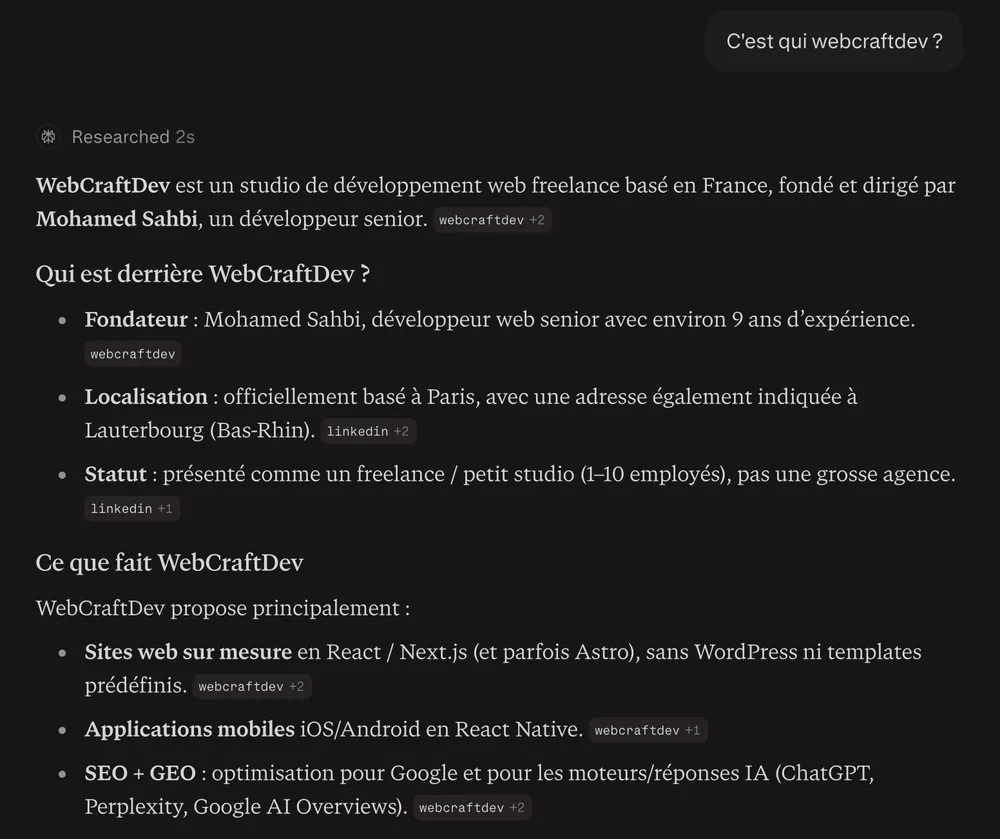
Ask Perplexity "C'est qui webcraftdev?" and it sums up my services, my stack and my positioning from this site, with no ads. That's what an AI-ready site produces. Reproducible test: open perplexity.ai and ask.
- Perplexity · 27 Sept 2026
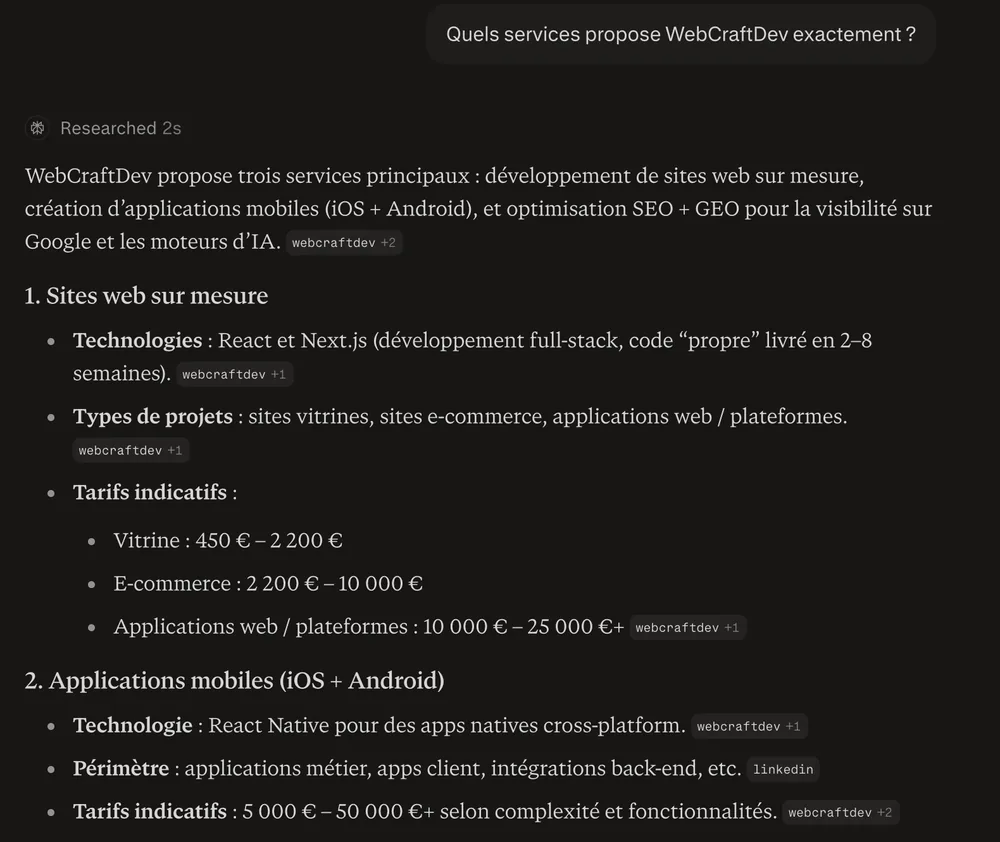
Pricing · Quoted by AI
WebCraftDev's public pricing is directly pulled by Perplexity from the /pricing page. The Schema.org markup + structured content lets the AI extract and display the information accurately.

- 01
SEO + GEO audit
Before you start€1,500 excl. VATIf you first want to know where you stand, the audit takes stock: technical health, content, authority and visibility in ChatGPT and Google's AI Overviews. Delivered within two weeks, with a prioritized action plan.
See the audit → - 02
Direct implementation
Weeks +1 to +4JSON-LD · SSR · CWVComplete technical audit, JSON-LD structured data, llms.txt and robots.txt configuration for AI bots, Core Web Vitals optimization, content restructuring for citability. Work done in your site's source code, not through a plugin.
- 03
Ongoing monitoring + optimization
Months +1 to +6+Monthly report · clear actionsMonthly monitoring of AI mentions, Google position tracking, synthetic report with next-month actions. Adjustments based on Google algorithm updates and LLM changes. Not a 40-page PDF, a clear summary with what should move.
3-month minimum commitment to let results materialize. All prices excluding VAT. To find out where you stand first, the SEO + GEO audit is €1,500 excl. VAT.
- 01 · Essentials3-month minimum
SEO + GEO foundations
€1,200/ monthSMBs that want to lay solid SEO foundations and start appearing in AI answers.
- Monthly technical audit
- Priority-fixed corrections
- 2 optimized articles per month
- Basic structured data (LocalBusiness, Service, FAQPage)
- robots.txt + llms.txt configuration
- Google position tracking (top 10 keywords)
- Basic AI monitoring (top 5 queries across ChatGPT, Perplexity, Claude, Gemini)
- Monthly synthetic report
- 02 · Growth3-month minimumPopular
Local domination + AI visibility
€2,400/ monthBusinesses that want to dominate their market on Google AND be recommended by ChatGPT, Perplexity, and Claude.
- Everything in Essentials
- 4 SEO + GEO optimized articles per month
- Citation engineering in your content
- Entity optimization (Wikidata, directories, profiles)
- Advanced AI monitoring (30+ monthly queries across ChatGPT, Perplexity, Claude, Gemini)
- Advanced schemas (Person, Article, BreadcrumbList)
- Sector-specific GEO strategy
- 03 · CustomScope-based
Full strategy for complex projects
Quote on requestHighly competitive markets, multiple cities or languages, e-commerce, full SEO rebuilds, SaaS.
- Customized multi-site / multi-language strategy
- Adapted content volume
- Advanced reporting + custom dashboards
- Direct access (Slack, WhatsApp)
- In-depth competitor analysis
- Custom semantic clustering
What happens each month is detailed in my article on what a GEO retainer includes.
I regularly publish technical articles on these topics. Here are the most useful starting points.
- 01
How to Choose a GEO Consultant in 2026: The Test That Exposes a Fake
The one test that separates a real GEO consultant from a rebranded SEO agency, published 2026 pricing, and the red flags to check before you sign.
- 02
Your Google Traffic Is Falling. Is It Really AI Overviews?
The method to settle it in ten minutes inside Search Console: an AI Overview drop, a ranking loss, or a drop that costs you nothing.
- 03
What a Monthly SEO and GEO Retainer Actually Costs in 2026
Published market ranges, what each budget level buys, why GEO is not billed separately, and how to compare two quotes.
- 04
Cited First by Google and ChatGPT: How It Is Done
A client named first by Google's AI Overview and by ChatGPT in three languages. The screenshots, the method, and how to check it yourself.
- 05
GEO: The Complete Guide to Generative Engine Optimization in 2026
Everything on GEO: definition, difference with SEO, llms.txt configuration, JSON-LD schemas, AI citation monitoring.
- 06
How to Get Your Site Cited by ChatGPT (technical guide for SMBs)
robots.txt configuration for GPTBot, content structuring for citation, concrete examples for European SMBs.
- 07
How to Appear in Perplexity and Claude (GEO)
Citation methodology for Perplexity and Claude: content structures, Person and Article schemas, ongoing monitoring.
Can't find your answer? Email me directly at mohamed-sahbi@webcraftdev.com or WhatsApp at +33 7 84 85 21 49.
SEO (Search Engine Optimization) optimizes your site to appear in Google’s list of results. GEO (Generative Engine Optimization) optimizes your presence to be cited in AI-generated responses: ChatGPT, Perplexity, Google AI Overviews, Claude, Gemini. The two are complementary: solid SEO is the foundation of GEO. Without strong SEO, AI engines have no reason to recommend you, because they rely heavily on Google’s results.
For technical SEO (page speed, indexation, Core Web Vitals), effects are visible within weeks. For Google ranking on competitive keywords: first movements measured in month 3, commercial searches take longer. For GEO: first AI citations measured in month 3, compared with the baseline. That's why the minimum commitment is 3 months.
Not always. I work on existing sites regardless of technology (WordPress, Shopify, Wix, custom code). However, if your site has deep technical problems (client-side rendering only, broken architecture, Lighthouse score below 30), I'll tell you straight. Sometimes rebuilding on a sound base is more profitable than patching for 12 months.
llms.txt is a file you place at the root of your site, like robots.txt, presenting your business to language models in a structured form. The honest answer on what it is worth today: Google states it ignores them, and an Ahrefs study of 137,000 domains in June 2026 found that 97% of published llms.txt files receive no requests at all, with no AI bot even checking whether one exists. I publish one anyway because it costs a generated page and a few agents do read it once they know the URL. What actually decides your AI visibility is server-side rendering, robots.txt permissions, structured data, and content written to be quoted. See mine: webcraftdev.com/llms.txt.
The main bots to allow in 2026 are: GPTBot (OpenAI / ChatGPT for training), OAI-SearchBot (ChatGPT search), ChatGPT-User (user browsing in ChatGPT), ClaudeBot (Anthropic), Claude-Web (Claude browsing the web), PerplexityBot (Perplexity), Google-Extended (Google AI), Applebot-Extended (Apple Intelligence). Without explicit authorization, these bots don't crawl your site, so your content can't be learned by the models or cited in generated responses.
Ask 10 to 30 questions representative of your sector to ChatGPT, Claude, and Perplexity, and note whether your brand appears. Bing Webmaster Tools has an "AI Performance" section that shows your citations in Copilot. For systematic tracking, every plan includes monthly monitoring of a key query set with reports on mentions, citations, sentiment, and opportunities where you don’t yet appear. To decide whether it's worth paying at all, I wrote up the five-minute test and the cases where it's money wasted: is paying for GEO worth it?
SEO (Search Engine Optimization) optimizes for traditional Google and Bing with link lists. AEO (Answer Engine Optimization) optimizes for response engines that give a direct answer: featured snippets, voice assistants, AI Overviews. GEO (Generative Engine Optimization) specifically targets LLM-based generative engines: ChatGPT, Perplexity, Claude, Gemini, Mistral’s Le Chat. In practice, AEO and GEO are often used interchangeably, with GEO emphasizing the generative LLM dimension.
No. I work with businesses in France, Belgium, Switzerland, Luxembourg, Germany, Austria, the United States, Canada, and the United Arab Emirates. I communicate in French, English, and German. SEO and GEO content can be produced in all three languages. This is particularly useful for DACH markets where the GEO opportunity window is even more open than in France, with less competition.
Because implementing SEO and GEO goes through the code. JSON-LD structured data, Core Web Vitals, llms.txt, SSR, semantic HTML5 tags, Person and Article schemas for E-E-A-T. A traditional SEO agency writes recommendations and sends them to your developer, who does what they can without strategic perspective. Here, I do both. No information loss between steps, no waiting, and every change is tested and verified directly in production.
The SEO + GEO audit goes through your site: technical health, content, authority and visibility in ChatGPT, Perplexity and Google's AI Overviews. €1,500 excl. VAT, delivered within two weeks.